
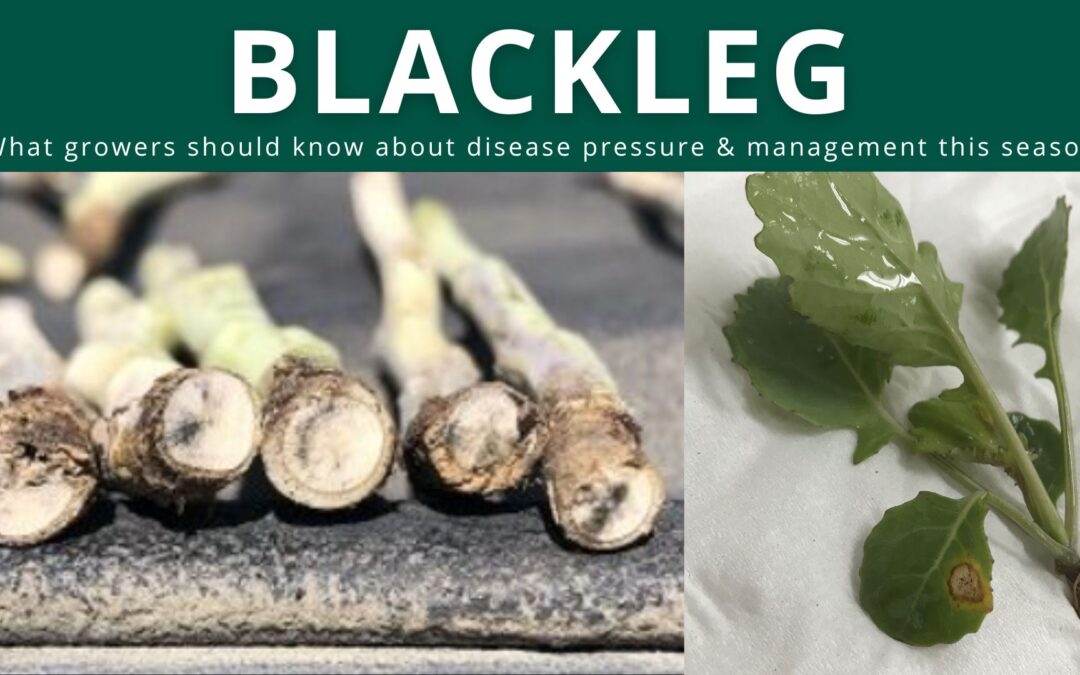
Why risk is higher this year
Blackleg remains one of the primary disease concerns in canola. Disease pressure was high across much of the area in 2024, leaving behind elevated levels of infected canola residue. As canola returns to some of these fields on a two-year rotation, the potential for early-season infection may be higher than normal.
Blackleg survives on infected canola stubble. In spring, that residue releases spores which can infect young canola plants shortly after emergence when moisture and temperatures are favourable.
Because infected residue is the main source of infection, shorter crop rotations generally carry a greater risk of disease. Fields that experienced higher blackleg levels two years ago may contain more inoculum, increasing the potential for infection early in the season.
While spores can move short distances through wind and rain splash, and infected residue may occasionally be spread by equipment, soil, or straw, the most important source of infection remains the canola residue already present within the field.
What conditions favour blackleg infection
Blackleg infection is driven mainly by moisture, temperature, and crop stage.
Moisture is the biggest factor. Frequent rainfall, heavy dew, and extended periods of leaf wetness all increase the chance of infection. Rain splash also helps move spores from infected residue onto young canola leaves.
Temperature plays a supporting role. Moderate to warm conditions are most favourable for infection. While cooler conditions can slow disease development, they do not eliminate risk when moisture is present.
The most vulnerable stage is the cotyledon stage. At this point, plants are small and humidity near the soil surface remains higher, especially in fields with heavier residue loads.
Blackleg risk is highest when infected residue, moist conditions, mild temperatures, and early crop staging all overlap.
What has already been done still matters
The two biggest long-term tools for managing blackleg are:
- Longer rotations away from canola where possible
- Choosing hybrids with good blackleg resistance
Even though those decisions are already made this year, they remain the foundation for managing overall disease pressure.
Fungicide timing is what matters now
Since the crop is already in the ground, fungicide timing becomes the main management tool for this season.
The key is to protect the plant before infection occurs. Blackleg spores can infect canola very early, often shortly after emergence when moisture and temperatures are favourable. Current recommendations are to apply fungicides between the cotyledon and two-leaf stage. That’s earlier than older recommendations, which often suggested applications from the two- to six-leaf stage.
When it comes to blackleg, earlier is generally better. Once the plant is infected, fungicides won’t reverse the disease, so timing is focused on protecting plants before infection occurs.
Fungicide options
There are a few different fungicide products that can be used for early-season blackleg management in-crop. Depending on the product, they can be applied:
- Tank mixed with glyphosate
- Tank mixed with glufosinate (Liberty)
- Applied as a separate pass
Your local HFL representative can help determine which fungicide products are the best fit for your fields.
Final thoughts
With elevated blackleg pressure coming out of 2024 and canola already emerged in many fields, now is the time to evaluate risk and plan fungicide applications where they fit. Timely decisions can help protect yield potential and keep blackleg from becoming a larger issue later in the season.
For more information on blackleg identification, resistance management, and best management practices, refer to the Canola Council of Canada’s Blackleg Management Guide.
If you have questions about blackleg risk, fungicide timing, or product options, reach out to your local Horizon Fertilizers agronomist for field-specific recommendations.
